March 1, 2026
From Brahms to Dvořák to Burleigh
by René Spencer Saller
Music history, like all histories, is one long and tangled tale of teachers and students. We might let ourselves get briefly bamboozled by certain Romantic myths and stereotypes—the solitary artist-hero nurturing a sacred innate genius, free from the corrosive influence of others—but most of us grow up at some point. Human creativity is cumulative, a collective endeavor performed over centuries. No one is more responsible for transmitting this precious legacy than the teachers and mentors—the Brahmses, Dvořáks, and Burleighs—who pass on the gift to their students, who then pass it along to their own students, and so on, ad infinitum (we hope).
A fun thought experiment: If Robert and Clara Schumann hadn’t evangelized on behalf of the young Hamburg pianist-composer Johannes Brahms, would he have done the same for Antonín Dvořák, an obscure and impoverished Bohemian violist-composer? And if he hadn’t found a mentor in Brahms, would Dvořák have met, much less employed, Henry Burleigh, a scholarship student and future champion of African American art song?
We don’t need to believe in destiny to be grateful for these connections. We just need music.
From Protégé to Peer
In 1874, after years of scraping by as a teacher and orchestra violist, Dvořák got his first big break: a grant from the Austrian Ministry of Education. The competition-based stipend was designed to help poor and talented young composers. Dvořák, the son of a zither-playing rural butcher and innkeeper, qualified on all counts. Even the notoriously hypercritical Brahms was enthralled by Dvořák’s 15 submissions. He praised the winning candidate’s “seemingly unlimited inventiveness,” his “uncanny sense of time and duration and dazzling sense of musical lines.”
Dvořák went on to win the prize two more times, and then, in 1877, thanks to an introduction by the influential Viennese critic (and fellow Ministry of Education juror) Eduard Hanslick, he met Brahms in person. The two composers hit it off, likely bonding over their working-class backgrounds. As a teenage saloon pianist in hardscrabble Hamburg, Brahms serenaded sex workers and drunken stevedores; when he first arrived in Vienna, he was sometimes dismissed as a handsome German hick. But the Viennese snobs had even more contempt for the Bohemians, whom they considered primitive, impulsive, superstitious, and generally inferior.
As Hanslick bluntly explained in an 1877 letter to Dvořák, “it would be advantageous for your things to become known beyond your narrow fatherland, which in any case does not do much for you.” Ironically, Hanslick was born and educated in Prague, but unlike his correspondent, he came from a bourgeois German-speaking family and identified as Austrian.
Although Brahms was only eight years older than Dvořák, he was already internationally famous, thanks to the first volume of his Hungarian Dances, a bestseller since 1869. His endorsement was coveted, and he doled it out sparingly. But after reviewing Dvořák’s scores, Brahms didn’t hesitate to recommend them to his own publisher, Fritz Simrock, who offered the 36-year-old composer his first major contract.
By 1880 Dvořák had attained both critical and commercial success, but this didn’t keep him from obsessing over Brahms’s opinion. In a letter to Simrock, written during the composition of the Seventh Symphony, Dvořák confessed his fear of disappointing his mentor: “I have been engaged in a new symphony for a long, long time; after all, it must be something really worthwhile, for I don’t want to hear Brahms’s words to me, ‘I imagine your [Seventh] symphony will be quite unlike [the Sixth],’ to remain unfulfilled.”
Luckily he had nothing to worry about. Grand, gloomy, and dramatic, the Seventh marked a distinct stylistic shift. His goal was to surpass all of his previous efforts and craft a symphony “capable of stirring the world, and may God grant it will!” Relatively free of the Slavic folk–derived, nationalistic elements for which he was known, it pays somber tribute to the High Classical canon. The influence of Brahms—particularly his recent Third Symphony, which Dvořák called the finest symphony ever written—suffuses all four movements.
Story continues below...
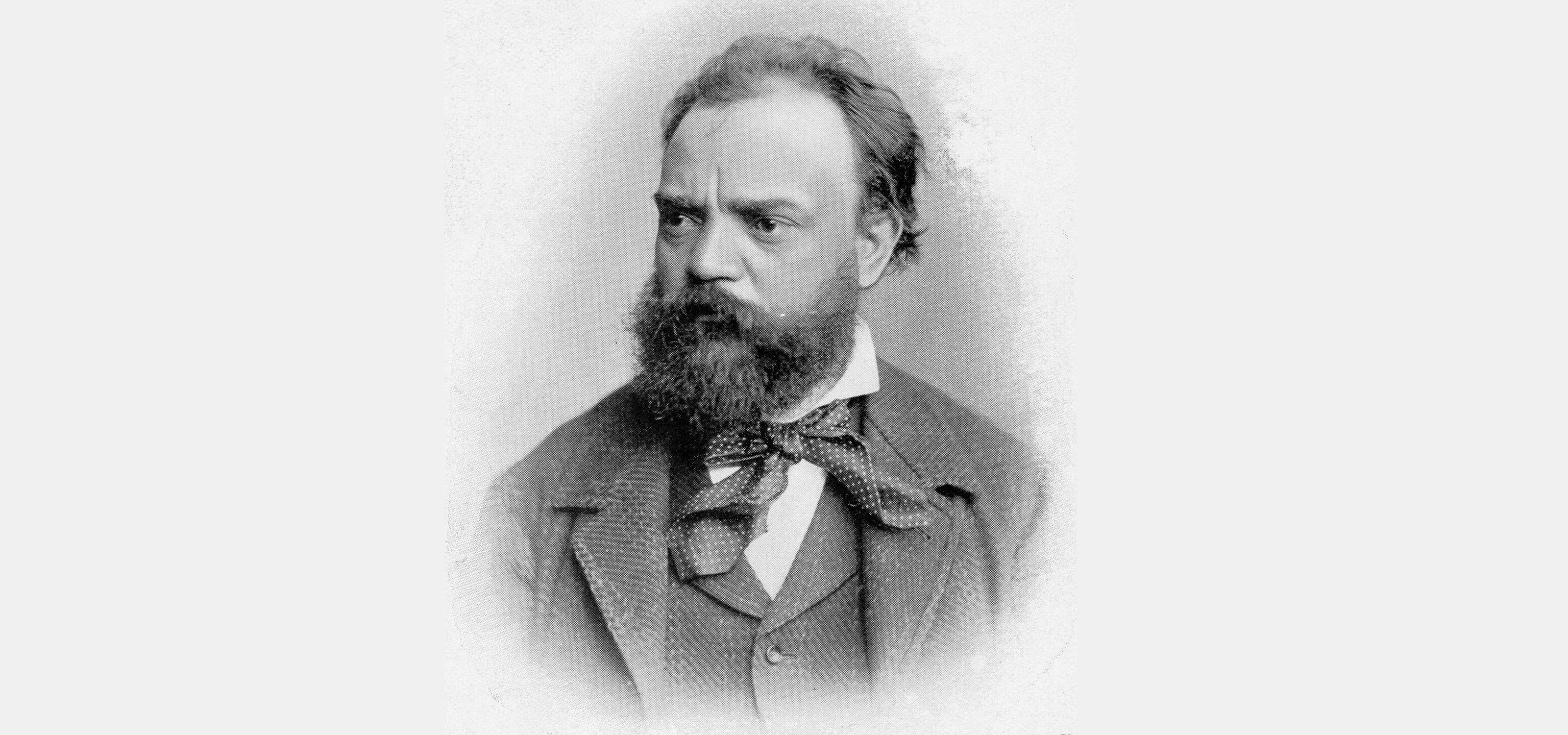
New Sounds from the New World
In September 1892, Dvořák, his wife, and two of their six children sailed from Prague to New York City, where they spent most of the next three years. Unlike so many other Czech immigrants before and after them, they never intended to start a new life in the New World. The 51-year-old composer was lured to the United States by Jeannette Thurber, a wealthy philanthropist and Paris-trained musician. She had already persuaded Congress to establish the National Conservatory of Music, her brainchild and life’s mission. Now she wanted Dvořák to serve as its director. He was reluctant at first, but the proposed salary of $15,000—more than 20 times what he had been earning at the Prague Conservatory—was too tempting to refuse.
Despite the thousands of extra miles between them, Brahms and Dvořák kept in touch, regularly exchanging letters and manuscripts. Brahms spent untold hours preparing Dvořák’s scores for publication, correcting all the transcription errors and perfecting the counterpoint. When he received the first draft of Dvořák’s Cello Concerto, he played it through on piano with a cellist friend and then laboriously proofread every bar. Dvořák marveled over his friend’s willingness to perform this tedious but essential task. “I don’t believe there is another musician of his stature in the whole world who would do such a thing,” he wrote.
After the Dvořáks returned to their homeland, in 1896, Brahms urged them to relocate to Vienna. The ailing bachelor even offered to make them his heirs. Dvořák was deeply touched by his friend’s generosity but unwilling to leave his beloved Bohemia. He visited Brahms on his deathbed and attended his funeral on April 6, 1897. That November Dvořák was appointed to the jury of the Austrian Ministry of Education, the same scholarship program that brought him to Brahms’s notice.
Dvořák drew inspiration from many sources, but mostly from the people he taught—who also taught him. Among the members of the National Conservatory’s diverse student body was his African American assistant Henry (“Harry”) Burleigh, who introduced the composer to what would soon become his favorite form of American folk music: the Negro Spiritual. For the best, most hummable theme of his Ninth Symphony, From the New World, Dvořák chose the English horn because it reminded him of Burleigh’s baritone. This haunting, hymnlike tune—apotheosized in the second movement but present, in some form or another, throughout—wasn’t a quotation from an existing spiritual, as many listeners mistakenly insist. Although inspired by Burleigh’s singing, it is an original melody, organic to the symphony.
In an essay titled “The Negro and His Song,” Burleigh reminisced about his close association with Dvořák:
“While I was never a student of Dvořák, not being far enough advanced at that time to be in his classes, I was constantly associated with him during the two years that he taught in the National Conservatory in New York. I sang our Negro songs for him very often and, before he wrote his own themes, he filled himself with the spirit of the old Spirituals.”
Burleigh, for his part, became a respected opera singer, composer, arranger, and lecturer. His inventive setting of “Deep River,” perhaps the first spiritual to enter the concert repertoire, was later immortalized by Paul Robeson and Marian Anderson. Listen closely to Burleigh’s arrangement, and you might hear an echo from the Largo of Dvořák’s Ninth, reverberating all the way back from Brahms and points beyond.
The source of that sound is a teacher.
René Spencer Saller is a Contributing Writer for the San Francisco Symphony and the main program annotator for the Dallas Symphony. She has also written for the St. Louis Symphony and Tippet Rise Art Center.
DVOŘÁK, BRAHMS, AND BURLEIGH AT THE SF SYMPHONY
MAR 5
Itzhak Perlman conductor and violin
BACH Violin Concerto No. 1 in A minor
BRAHMS Academic Festival Overture
DVOŘÁK Symphony No. 8
MAR 13 & 15
Daniele Rustioni conductor
Daniel Müller-Schott cello
BRAHMS Symphony No. 2
DVOŘÁK Cello Concerto
MAR 15
Pinchas Zukerman violin
Shai Wosner piano
BRAHMS Violin Sonatas Nos. 1, 2, & 3
MAR 20–22
Andrés Orozco-Estrada conductor
Jan Lisiecki piano
DVOŘÁK Symphony No. 7 and
works by WEBER and MOZART
MAY 3
Chamber Music with SF Symphony Musicians
BURLEIGH Selections from Plantation Melodies Old and New
MAY 22–24
Cristian Măcelaru conductor
Simon Trpčeski piano
DVOŘÁK Symphony No. 9, From the New World and
works by TYLER TAYLOR and
SERGEI RACHMANINOFF