April 1, 2026
A look behind the San Francisco Symphony’s education programs
By Emma Silvers
It’s a February afternoon in San Francisco, and at Harvey Milk Civil Rights Academy, a group of about 40 young students are on a journey. Seated in the public elementary school’s auditorium, the first- and second-grade classes are being transported throughout the city—Golden Gate Park, Chinatown, Mission Dolores—by the Camino Trio, a group of professional musicians from the San Francisco Symphony’s Fisher Family Adventures in Music (AIM) program.
“In the Fillmore neighborhood, you can hear another kind of American music called jazz,” says harpist Anna Maria Mendieta. “Can you say ‘jazz’?”
“Jazz!” shout the kids. And they’re off, as the trio leads a kids’ version of the Gershwins’ standard “I Got Rhythm” on harp, cello, and flute, complete with follow-along hand gestures on every line.
These young travelers are at the start of another journey as well: Thanks to the nearly 40-year collaboration between the Symphony and the San Francisco Unified School District—the longest-running partnership of its kind in the nation—students can experience free, thoughtfully designed music programming during every year of their public school education.
Story continues below...
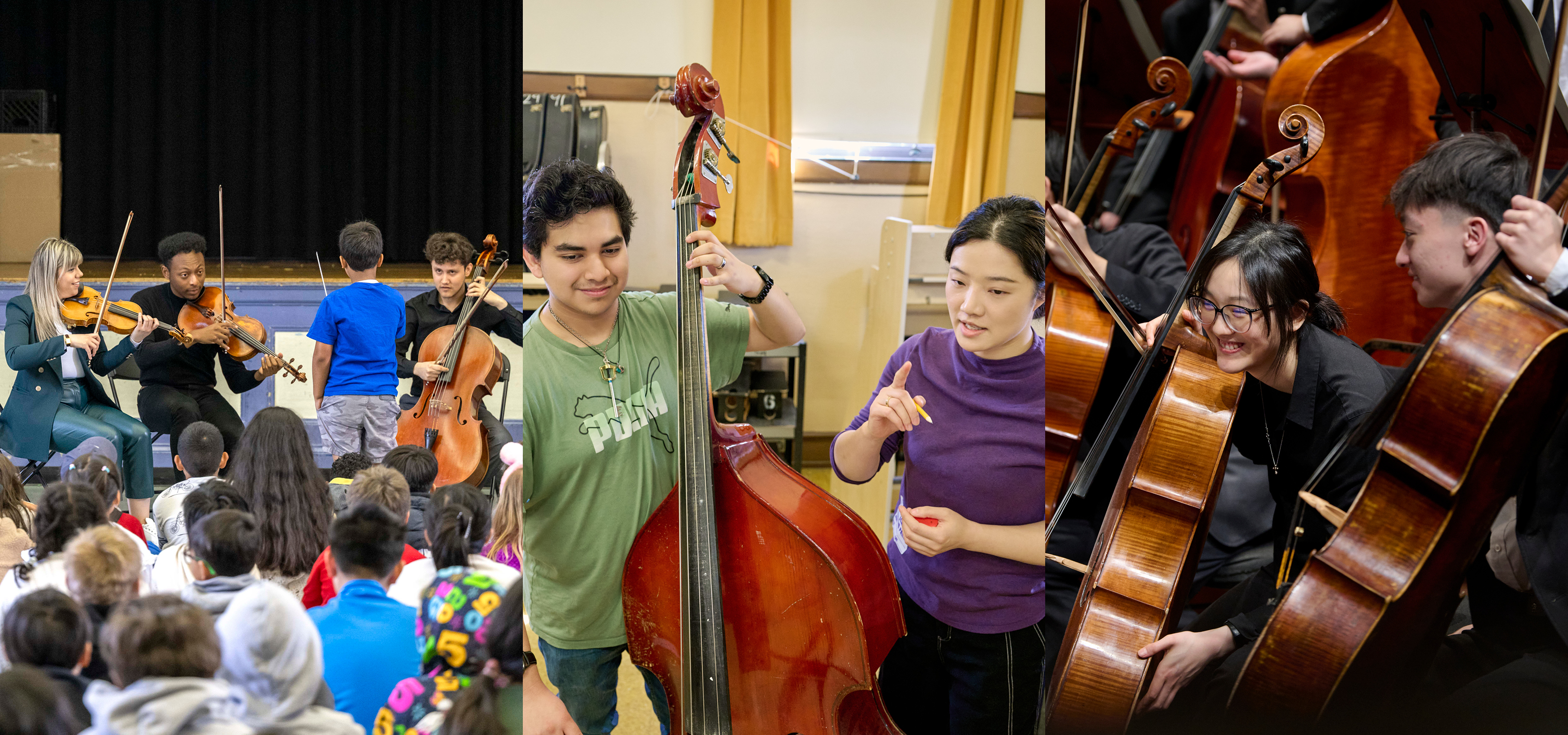
Between AIM (which serves students in grades 1 though 5), Music and Mentors (serving grades 6 through 12), and the San Francisco Symphony Youth Orchestra (for musicians under the age of 21), the Symphony has changed hundreds of thousands of lives. These programs give students of all backgrounds their first taste of classical music, plant a seed for future musicians and Symphony-goers alike, and provide budding performers with invaluable personal mentorship—all at no cost to the school district or to families.
In the orchestral world, these offerings are revered: The New York Times has referred to the SF Symphony as “a music education powerhouse,” while the Wall Street Journal called the Symphony’s education programs “the industry standard.” But the average San Franciscan might not know they exist.
With that in mind, here’s a spotlight on just a few of the ways the San Francisco Symphony works to ensure quality music education is accessible to all—and instill a love of music for generations to come.
“A Two-Way Conversation”: Fisher Family Adventures in Music
Mendieta, the harpist, is a celebrated musician known for her groundbreaking work composing and performing Argentine Tango. She’s toured the world, won prestigious awards, and performed at the Vatican and Carnegie Hall.
But to hear her tell it, there’s nothing quite like playing music for children.
“It’s so meaningful, and so different every time,” says Mendieta, who’s been with AIM since 2015. “With kids, there are so many different personalities, and so many different needs, and we have to figure out how to reach them. It challenges me to connect with every type of audience—really connect with them, right? Kids can tell when you’re not sincere!”
Founded in 1988, the Fisher Family Adventures in Music program sends trios and quartets of musicians—some focused on woodwinds or percussion, others focused on jazz, and others on Latin American music—into San Francisco public schools each school year with performances and workshops that are tailored to each age group. Each AIM season culminates in a dedicated concert just for students featuring the full San Francisco Symphony at Davies Symphony Hall. More than 20,000 students at nearly 80 schools took part in an AIM performance in the 2024–25 academic year.
Under the umbrella of a different theme each season (the current theme is “Music of San Francisco, Music of the World”), the AIM ensembles perform in a range of styles, incorporating some songs you might hear in a traditional Symphony performance at Davies Symphony Hall—and other songs the kids will recognize, like the “Star Wars” or “Jurassic Park” themes. The Symphony also produces educational workbooks, crafts, and other interactive materials aligned with curriculum standards and customized to the needs of teachers and students.
AIM live ensemble presentations follow a thoughtfully written script, but Mendieta has learned when it’s important to improvise, as well: The musician remembers one of her first school experiences over a decade ago, when her trio visited a school with a particularly excitable group of kids.
“The teachers were trying to get them to be quiet, and it wasn’t working, and I know all of us were feeling a bit of stress and tension, wondering what this was going to be like,” she recalls. “But once we played music, they calmed down. And we realized, for that program, for that group, we needed more music, less talking. Once the music started, they were engaged.”
Ron Machado, director of the Arts Department for SFUSD and a former school principal, has had a front-row seat to Adventures in Music’s evolution as a program over the last decade or so. He also has perhaps a better sense than anyone of the gaps AIM is filling, as funding for music education in public schools is often first on the chopping block during a budget deficit.
“[The program] exposes students to something that they might not get otherwise,” says Machado. “Whether or not their interest [in classical music] continues, they come away understanding more about instruments, and being an audience member, and the teamwork it takes for all the artists to come together and make something like a symphony happen.”
At a school visit last year during an AIM session, he recalls the “buzz and excitement” after students were invited up to touch the instruments after the performance. The program’s emphasis on incorporating music and musicians from different cultures, he says, has been key to AIM’s success.
“They’re bringing in artists that look like a lot of our students, and I think they really tapped into that need—making sure students can see themselves in the performers,” says Machado. “It becomes a two-way conversation.”
“A Life-Changing Experience”: Music and Mentors
Once students arrive in middle school, they’re ready for the next leg of their Symphony journey: Music and Mentors. In this program, which began in 2005, professional musicians visit middle and high school bands and music classes weekly for small group sectionals and invaluable one-on-one instruction.
Kelci Hartz, the jazz band teacher at Lowell High School, has been at the school for four years, and says the experience would be wildly different without Music and Mentors.
“I’ve never taught somewhere before that had a program like this,” says Hartz, who’s taught grades kindergarten through 12th at public schools in both the United States and Korea. “Other places, there’s private instruction available if [students’ families] pay for it, but it’s truly so, so special that this is available to these kids for free.”
In the 2024–25 school year alone, some 4,800 SFUSD students were served by the Music and Mentors program during more than 4,200 instructional hours. Teaching artists mentored students on violin, viola, cello, double bass, electric bass, guitar, flute, clarinet, saxophone, oboe, bassoon, cornet, trumpet, trombone, French horn, euphonium, Sousaphone, tuba, and percussion.
Mentors also arrange for necessary repairs and instrument replacements (paid for by the Symphony); assist with special trips for advanced-level high school ensembles, like Lowell High School’s Symphonic String Orchestra who will travel to play Carnegie Hall later this spring; and provide free tickets to SF Symphony performances, such as the Lunar New Year and Día de los Muertos concerts, open rehearsals, and Teen Night.
“It’s just a life-changing experience,” says Louella Hasbun, a cellist and teaching artist with Music and Mentors. “A lot of these kids can’t afford private lessons outside of school, and you see how it just brings up the level [of playing] tremendously.”
Many former students who were mentored as youth are now professional musicians, and some are teaching artists with the program themselves. But even with students who don’t choose music as a career, the impact can be profound, adds Hasbun, who has been with the program for 20 years.
“Some of these kids have really difficult home situations, and music turns out to be the island of sanity in the midst of all of it,” says Hasbun, who currently mentors 52 middle and high school cello players in the span of each week. “Music is one of the precious things, one of the beautiful things, and this is where we should put our energy. It incorporates every aspect of being human: the physical aspect, your mind, and your heart.”
For Patrick Kroboth, an accomplished violist and teaching artist with Music and Mentors for 17 years, connecting with budding musicians through the program has become one of his central passions. “The kids really respond to our brand of teaching, because it’s not just ‘OK, get in here, play your scales,’” he says.
“We’re all seasoned professionals, so we bring this perspective of personal experience that would not ordinarily be part of a classroom curriculum. Once the kids tap into that, they realize, ‘Oh, these people know stuff from their life experience.’... I don’t mean to downplay it, but it’s actually such an easy job: You just go in and literally share your life’s experiences, and that makes a difference.”
In 2016, when Music and Mentors faced a critical juncture, Kroboth and his fellow teaching artists put out a call for testimonials about the program. They were overwhelmed at the response: Kroboth still treasures a folder filled with more than 100 handwritten letters from students, parents, and teachers, some of which were read at the San Francisco Symphony’s annual meeting.
“These coaches leave a deep impact on us as musical scholars,” wrote one George Washington High School sophomore. “These lessons … change how we take on the course of life, help us grow as people, as musicians in a whole other way.”
The outpouring of support made a lasting impression and the program moved forward with renewed commitment. Today, Music and Mentors continues to thrive into its third decade.
Wonder and Discovery: San Francisco Symphony Youth Orchestra
Cadence Liu clearly remembers her first time playing with the San Francisco Symphony Youth Orchestra. The flutist was a sophomore at Woodside Priority High School in Portola Valley and was excited to have gotten into the orchestra after her second time auditioning.
At the first rehearsal, they played Maurice Ravel’s Mother Goose.
“It was one of the most spiritual moments of my life,” says the musician, now a sophomore at Stanford. “This was one of the first times I’d played in an orchestra where it seemed like everyone had themselves figured out… so instead you focus on each other, and on putting something together. You become like an organism; it’s a physical feeling. It’s almost like you can disappear.”
Founded in 1981, the SFSYO is the Symphony’s highly competitive preprofessional training program. It’s open, by audition, to musicians under the age of 21—and, unlike many other youth orchestras, it’s free to participate. Young musicians come from as far as Sacramento and Fresno to rehearse and perform at Davies Symphony Hall, where members have access to San Francisco Symphony musicians as coaches.
The ensemble performs three ticketed concerts per year and an annual fan-favorite Peter and the Wolf concert around the holidays, as well as regular performances around the Bay Area. The SFSYO has also toured extensively, bringing the youth of the Bay Area to hallowed concert halls in New York, Europe, and Asia.
Liu is a composition major—she’s considering double-majoring in international relations—and says she doesn’t know what the future holds. She does know that the role SFSYO has played in her life thus far will be hard to duplicate.
“Whenever I think about the fact that I’m going to have to leave the YO I get very stressed,” says Liu with a laugh. “I’ve made so many amazing friends from around the Bay Area, and I get so much spiritual fulfillment from it… it’s such a big part of why I want to stay in music.”
Adam Smyla, an SF Symphony violist and coach for the SFSYO since 2005, says this is a common refrain from the young musicians he works with. There’s a special alchemy, he thinks, that comes from a competitive program that attracts only the most talented, ambitious students—then encourages them to work together to find the magic in a given piece of music.
“They practice alone at home, so they learn the notes technically ... but when we work together, we create music,” says Smyla. “I love watching them experience a piece together for the first time. There’s wonder. You can see this incredible discovery on their faces.”
“Don’t get me wrong, I am very demanding. This is not a vacation,” adds Smyla with a laugh. “But to create a team from individual players is the most important thing for me. They feel that they belong, that they matter. It’s a place for them to actually discover who they are, to make friends with people that are as passionate as they are, in an extremely safe and creative environment.”
The paths that SFSYO alumni follow speak for themselves—they can be found in leadership positions in world-class orchestras across the world. Smyla recalls being on tour in Tapei and running into two former students of his, now working musicians who were also coaching a youth orchestra there, themselves.
Of course, they can also be found right here in Davies Symphony Hall, as eight current San Francisco Symphony musicians came up through the SFSYO.
Among them are Amos Yang, the San Francisco Symphony’s Assistant Principal Cello and occupant of the Karel & Lida Urbanek Chair, who joined the SFSYO’s inaugural class in 1981 at age 11.
Yang studied at Juilliard and played with the Seattle Symphony before landing back home in San Francisco nearly 20 years ago. He loves to participate in the Symphony’s free Community Chamber Concerts at San Francisco Public Library branches, because he believes that every child should have access to music. Every young person, he says, deserves the chance to kick off their own journey with the San Francisco Symphony, wherever it may lead.
If any of the six-year-olds participating in AIM today at Harvey Milk are as lucky as Yang, it’s a journey that just might lead them right back to Davies Symphony Hall.
“I really don’t take that for granted,” he says, of the mentorship he experienced—and how rare it is that he gets to play in the world-class orchestra in his hometown. “It’s been a great ride.”
Emma Silvers is a San Francisco arts and culture journalist.